UCSC Department of Astronomy & Astrophysics

Claire Dorman
Research
Structural decomposition of M31: Late-type galaxies are usually decomposed into their component disk, bulge and halo via surface brightness profile fitting, but this technique is subject to strong degeneracies in the best-fit components. We explored the effect of including additional constraints from resolved stellar kinematics and photometry on a surface brightness decomposition of the Andromeda galaxy (M31). We found that the fraction of light contributed by the dynamically hot component is significantly larger than that contributed by a bulge and halo alone. It is possible that there is a population of stars born in M31’s disk that were “kicked out” -- dynamically heated such that they kinematically resemble halo members but retain their disk-like luminosity function and surface brightness profile.
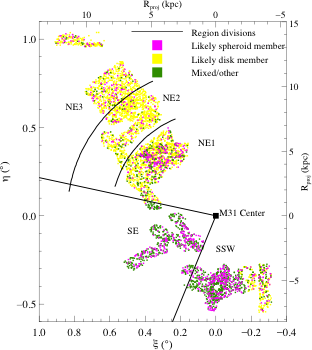
Kinematics of M31’s inner spheroid: We kinematically decompose the disk-dominated region of M31 into dynamically cold “disk” (thin disk + thick disk) and dynamically hot “spheroid” (bulge + halo) using Keck/DEIMOS-derived radial velocities of over 5000 individual bright (20 < I < 22) red giant branch stars. We find that the dynamically hot spheroid is quite extended, contributing 10-20% of this RGB population out to galactocentric radii of at least 20 kpc -- much more so than one would expect based on the size of the Milky Way’s bulge. The pink data points in the map on the right denote the locations of likely spheroid members. Collaborators: Raja Guhathakurta, Mark Fardal, Dustin Lang, Anil Seth, Julianne Dalcanton, PHAT team, SPLASH team.
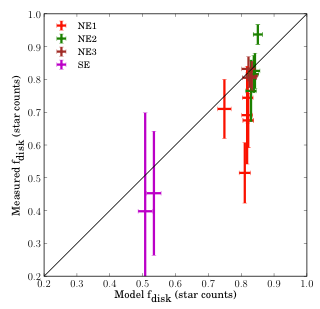
Dorman et al. (2013), ApJ, in press
Toy model consistently over-predicts disk fraction when disk is assumed to be cold.

Hypervelocity stars in the Milky Way’s central parsec: My interests in both research and astronomy were sparked during the UCLA Physics and Astronomy REU program in summer 2008. I worked with Professor Andrea Ghez and graduate student Sylvana Yelda in a search for hypervelocity stars, objects with radial velocities greater than the escape speed of the Milky Way, near their suspected birthplace at the Galactic Center. I wrote a reduction pipeline for the multiepoch K-band LGSAO images from the OSIRIS integral-field spsectrograph and measured tangential velocities of 1700 stars. Assuming a cusp model for mass distribution in the vicinity of the central black hole, we found two candidates gravitationally unbound to the Galactic center. In the process, we noticed directed flow patterns in the velocity maps of the field, indicative of optical distortion change in the OSIRIS imager between our observation runs. arXiv abstract here.
Collaborators: Raja Guhathakurta, Larry Widrow, Anil Seth, Dan Foreman-Mackey, Julianne Dalcanton, PHAT team, SPLASH team.
Digital reconstruction of audio data in wax cylinders: Dr. Carl Haber at Lawrence Berkeley National Laboratory is trying to preserve music and samples of now-extinct Native American dialects that are stored in the grooves of hundreds of century-old wax cylinders. The cylinders cannot be replayed in their present condition because they are old and moldy. Haber is trying to optically scan the grooves with a machine called IRENE to create a database that can be replayed without destroying the artifacts. My job was to write LabView code that would determine the height of IRENE's scanner above the surface of a particular cylinder for optimal groove resolution. I graduated before the project was completed, but you can follow the progress on the IRENE web site.